Heating in winter with a reversible air conditioner: settings, defrosting and mistakes to avoid

The EcoClimo team
14 Oct 2026 - 04 min read
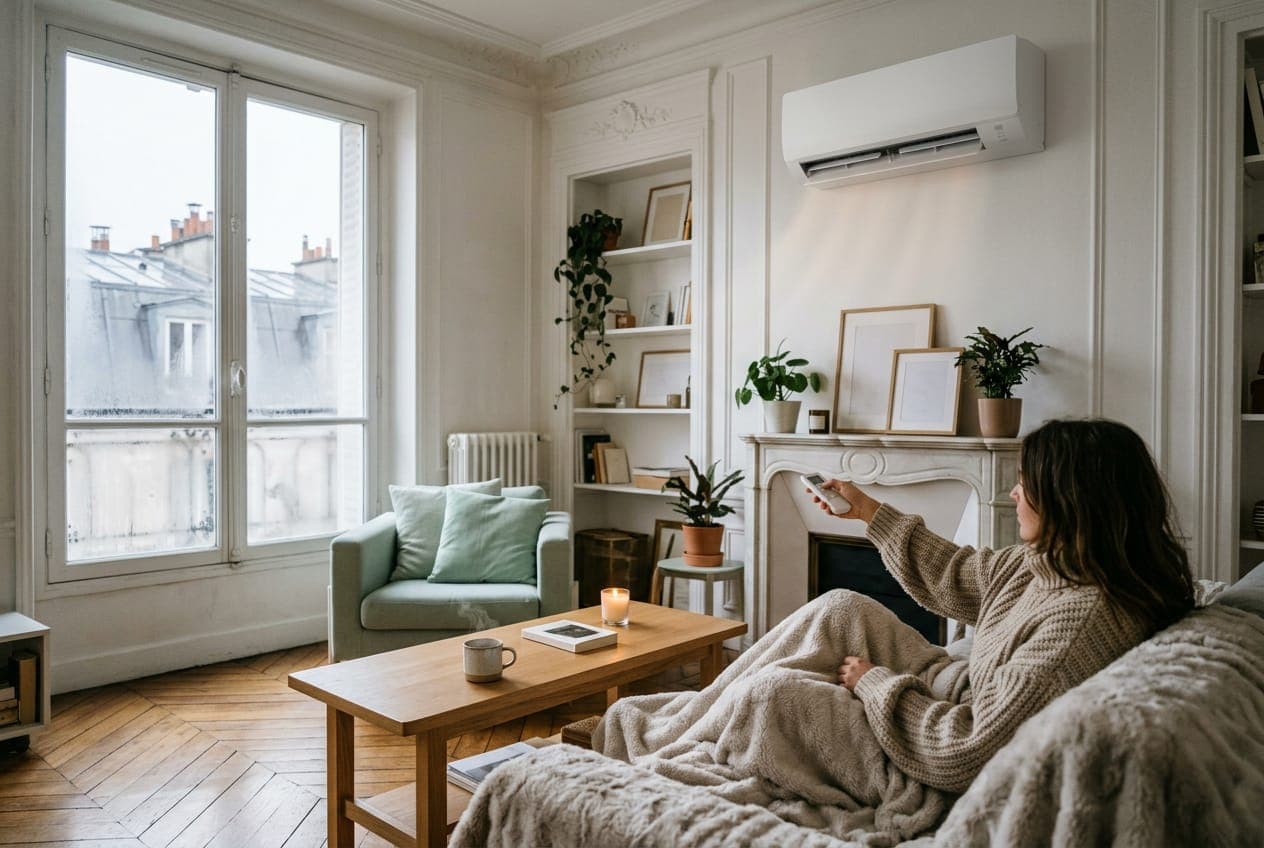
A reversible air conditioner is not just for summer. In heating mode, it works as an air-to-air heat pump: it draws heat from the outside air, even when it is cold, and releases it inside your home. For the same amount of heat, it uses considerably less electricity than a conventional electric heater.
It still needs to be set up properly, though. A set point that is too high, badly angled louvres or a cluttered outdoor unit are enough to push up the bill and spoil your comfort. Here is how to get the most out of your unit during the cold season.
Choosing a reasonable set temperature
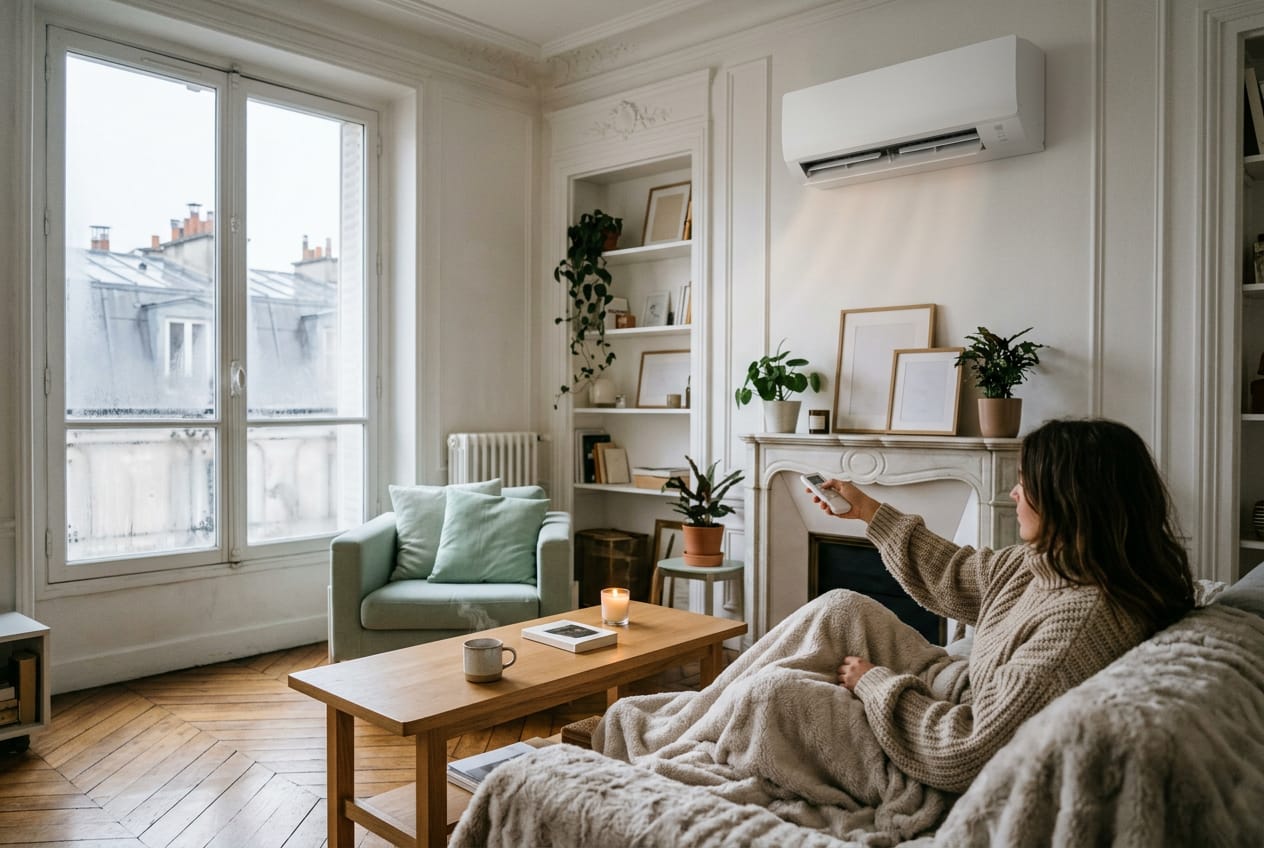
This is the setting with the biggest effect on consumption. ADEME, the French environment and energy agency, recommends around 19 °C in living areas and 16 to 17 °C in bedrooms. It also estimates that one degree less saves in the region of 7% on heating consumption. That order of magnitude is enough to show what is at stake: going from 22 °C to 19 °C is far from trivial.
Watch out for a common trap: the temperature shown on the remote is not always the one you feel. The unit's sensor sits inside the indoor unit, often high up, where the air is warmest. An indoor thermometer and hygrometer placed at sofa height gives you the room's real temperature. You can then adjust the set point knowingly, rather than turning it up out of habit.
A few practical pointers:
- Avoid sudden changes. An inverter reversible air conditioner is more efficient when it holds a steady temperature than when it has to restart hard after being switched off completely.
- Turn it down at night or for short absences, by 2 to 3 °C, rather than switching it off altogether.
- Use the timer or away mode if your unit has one. Some models offer a low-temperature hold, useful for a second home or when you are away for several days.
Directing the air and choosing the fan speed
Warm air rises. In heating mode, point the louvres downwards so the heat reaches the floor and the areas you use before rising again. Louvres left horizontal, as in summer, let the heat build up under the ceiling.
For fan speed, automatic mode is usually the right choice: the unit blows hard at start-up, then slows down once the set point is reached. A permanently minimum speed may seem quieter, but it lengthens the warm-up time.
Finally, let the air flow. A sofa pushed right under the indoor unit, a heavy curtain in front of it or a tall piece of furniture nearby all disrupt heat distribution and the sensor's reading.
Understanding defrosting
In cold, damp weather, typically around 0 to 5 °C with fog or drizzle, ice forms on the outdoor unit's coil. To get rid of it, the unit periodically runs a defrost cycle. For a few minutes:
- the indoor unit stops blowing, or blows very gently;
- a dedicated indicator light may come on, depending on the brand;
- the outdoor unit may give off steam and drip water.
All of this is normal. It is neither a breakdown nor a leak. On the other hand, very frequent defrost cycles, an outdoor unit encased in ice that does not melt, or a unit that can no longer heat call for a technician's opinion.
It is also normal for efficiency to drop when it is very cold outside: there is less heat to capture from the outside air. That is one more reason not to overheat your home.
The outdoor unit in winter
In summer, the outdoor unit rejects heat; in winter, it absorbs it. Either way, it always needs to breathe.
- Do not cover it while it is running. A cover or tarpaulin blocks the airflow and encourages frost. Protection only makes sense if the unit stays off all winter.
- Clear fallen leaves and snow around and in front of the grille.
- Keep an eye on drainage. In heating mode, defrost water runs out of the outdoor unit. On a balcony or terrace, it can freeze and make the floor slippery. A properly connected drain pipe solves the problem.
Common mistakes
| Mistake | Consequence | Better approach |
|---|---|---|
| Setting 24 °C "to heat up faster" | The unit does not heat faster, it just uses more | Set the temperature you actually want |
| Louvres pointing at the ceiling | Heat trapped up high, cold feet | Point the louvres downwards |
| Switching off completely every time you go out | Hard restart on your return | Turn it down a few degrees |
| Filters not cleaned since summer | Reduced airflow, higher consumption | Clean the filters before the heating season |
| Window left ajar all day | Continuous heat loss | Air the room for 5 to 10 minutes with the unit off |
Heating makes the air feel dry: cold outside air holds little moisture, and once warmed, its relative humidity falls. Airing briefly every day is still essential to refresh the air, but it is better done thoroughly and quickly. To limit constant cold draughts, a simple door draught excluder under a door onto a cold hallway already makes a difference.
These settings are part of our energy sufficiency approach: a well-adjusted, well-maintained unit heats better while using less.
Getting ready for the heating season
An air conditioner that has run all summer reaches autumn with loaded filters and a dirty coil. Before the first cold snap, servicing and cleaning puts the unit back in shape: filters, coils, condensate drain, operating readings in heating mode. It is also a chance to spot a drop in performance before it leaves you without heating in the middle of January.
Unsure about the right settings, or wondering whether your reversible air conditioner can heat your whole home or your shop on its own? Our advice and support service looks at your situation and answers with no obligation. Write to us via the contact page for a free quote.
Ready for cooler, healthier air?