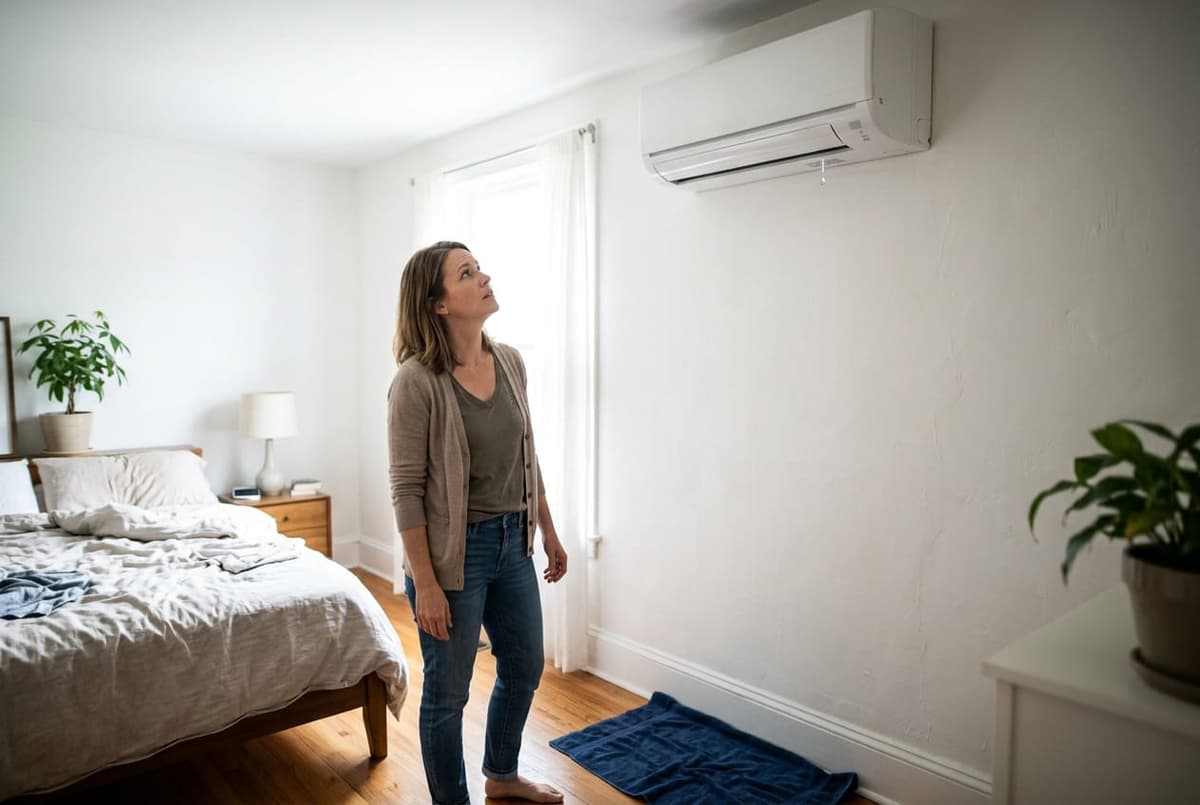
Rental AC: who maintains it, who pays?

L'équipe EcoClimo
10 Nov 2026 - 08 min read
In a Paris flat fitted with a reversible split system, the same question comes up at the same time every year: should the tenant call in an air conditioning technician, or is it up to the landlord to arrange it? And when the unit breaks down, who settles the bill?
The answers are not left to personal judgement. They follow from the lease, from the decree listing tenant-liable repairs, and from the European regulation on refrigerant gases. Here are some concrete benchmarks to avoid tense discussions when the final property inspection comes around.
First step: establish who owns the unit
Before discussing maintenance, you need to determine the status of the air conditioner. Three situations are common in the Paris region, and they do not carry the same obligations.
The unit is part of the rented home. It was already there when the tenant moved in, it appears in the move-in inventory and sometimes in the description in the lease. It is part of the property's equipment: the landlord must hand it over in good working order and keep it fit for its intended use, in accordance with Articles 1719 and 1720 of the Code civil (French Civil Code) and Article 6 of the Act of 6 July 1989.
The unit was installed by the tenant. It belongs to them. They are responsible for its maintenance and repairs and, in most cases, for restoring the walls and façade when they leave, if the landlord requires it. Be careful: installing an outdoor unit without the landlord's written consent, and without authorisation from the general meeting in a shared building, can lead to a demand for removal.
The unit is shared building equipment. This covers ducted systems serving several units or systems fed by a central plant. Maintenance then falls to the managing agent and to the building's service charges, part of which can be passed on to the tenant.
A useful habit: re-read the move-in inventory and the lease before any discussion. An air conditioner listed in the inventory, with its brand and condition, settles half of all disputes on its own.
Routine maintenance: the tenant's job, in practice
For an air conditioner that forms part of the rented home, responsibility follows the French logic of tenant-liable repairs. Decree no. 87-712 of 26 August 1987 lists the repairs and routine maintenance that fall to the tenant: cleaning, replacing wear parts, and minor repairs linked to normal use.
Applied to an air-to-air air conditioner, that works out in practice as follows:
| Tenant's responsibility | Landlord's responsibility |
|---|---|
| Regular cleaning of the indoor unit's filters | Original design or installation defect |
| Keeping the outdoor unit clear (leaves, dust) | Replacing the compressor or the control board |
| Annual servicing if the lease provides for it | Refrigerant leak in the circuit |
| Replacing the remote control batteries | Wear and tear: unit at the end of its life |
| Damage caused by improper use | Bringing the power supply circuit up to standard |
Cleaning the filters is the basic step, and it requires no dismantling: take them out, dust them off, rinse them in lukewarm water and let them dry completely. Cleaning the filters every two to four weeks in peak season is enough for most homes. Many tenants simply use a cordless handheld vacuum for this; a model with a soft brush avoids crushing the filter media. Our guide to the signs that an air conditioner needs attention is a useful complement to this routine.
The lease can go further and make annual professional servicing the tenant's responsibility, as is commonly done for an individual boiler. Such a clause is valid as long as it covers routine maintenance, not major repairs: a clause placing wear and tear or replacement of the unit on the tenant would be deemed void.
What remains the landlord's duty, whatever the lease says
The landlord cannot transfer to the tenant the obligation to deliver the property and maintain its structural equipment. Three items always stay on their side:
- Major component failures. Compressor, fan motor, control board, heat exchangers: these parts have a service life longer than any lease, and their failure does not result from everyday use.
- Refrigerant leaks. The circuit is sealed; the tenant has no access to it. A simple top-up without leak detection is in fact prohibited by European Regulation (EU) 2024/573 on fluorinated greenhouse gases, which requires the leak to be repaired before any recharge.
- Wear and tear. A fifteen- or twenty-year-old split system that can no longer hold the set temperature needs replacing, at the landlord's expense. Our article on air conditioner capacity and sizing is helpful before any replacement: the room may well have changed (new windows, upgraded insulation) since the original installation.
If the property is more than two years old, maintenance and repair work qualifies for the reduced VAT rate of 10%. That is the rate applied to our servicing work, and the invoice must show it clearly, whether it is addressed to the landlord or the tenant.
Mandatory servicing: what the rules actually say
Contrary to what you sometimes read, there is no general obligation in France to have a small domestic air conditioner serviced every year. The real obligations cover two distinct areas.
Leak-tightness checks under the refrigerant rules. Regulation (EU) 2024/573, which replaced the 2014 F-Gas Regulation, requires periodic leak checks on equipment whose charge reaches a given threshold expressed in tonnes of CO₂ equivalent. Most residential split systems, charged with less than a kilo of R32, fall below that threshold. Large multi-split systems, ducted systems and systems in shops or offices, on the other hand, frequently come within scope. Any work on the refrigerant circuit, however, requires a company holding a certificate of competence (attestation de capacité) and a certified operator: this is required by the Code de l'environnement (French Environment Code), Article R. 543-76 et seq.
Periodic inspection of air conditioning systems. Systems with a useful rated output above 70 kW are subject to periodic inspection under the Code de la construction et de l'habitation (French Construction and Housing Code). That applies to commercial premises and shared buildings, not to an individual flat.
For a typical rented home, annual servicing therefore remains a contractual obligation (whether or not the lease provides for it) and a matter of common sense, not a legal requirement. ADEME points out that a clogged filter and a dusty heat exchanger noticeably reduce efficiency: the machine uses more energy for less comfort.
The paperwork each side should keep
This is what settles disputes when the tenant moves out. Both parties benefit from putting together a small file, even a basic one.
For the tenant:
- the move-in inventory, mentioning the air conditioner and its condition;
- annual servicing invoices, if they are responsible for it: they prove the obligation has been met;
- written visit reports, which date the findings and flag points to watch;
- written exchanges with the landlord in the event of a breakdown — a dated email is worth more than a phone call.
For the landlord:
- the original installation invoice, with the unit reference and the refrigerant charge;
- the certificate of competence of the company that worked on the refrigerant circuit;
- the history of servicing and repairs, useful later when deciding between repair and replacement;
- the manufacturer's manual, to be left in the property: it prevents a lot of risky handling.
An A4 document archive binder is enough to keep this history in one place, especially when managing several properties. For landlords letting furnished accommodation, leaving a property maintenance logbook on site makes handover between tenants much easier: filter cleaning dates, visits and any anomalies observed can all be noted in it.
We always provide a written report after a visit, precisely because it is the document that lets both tenant and landlord know what was done and what needs watching. Our service commitments set out this principle in detail.
A breakdown during the tenancy: the right sequence
When the unit stops or blows lukewarm air, the order of the steps matters as much as the diagnosis.
- The tenant checks the simple things. Circuit breaker, mode selected on the remote, temperature setting, clogged filters, obstructed outdoor unit. A good share of reported "breakdowns" turn out to be settings or a blocked filter.
- They notify the landlord in writing. Date, symptom, and what has already been checked. It is this notification that triggers the landlord's repair obligation.
- The landlord calls in a qualified company. If the refrigerant circuit is involved, the certificate of competence is mandatory; asking for the number is good practice.
- The diagnosis decides who pays. Filter, cleaning, condensate drain blocked by limescale: routine maintenance. Compressor, leak, control board: the landlord's repair.
- If the situation drags on, the tenant can refer the matter to the departmental conciliation commission, free of charge, before starting any court proceedings. Contact details are available on service-public.fr.
The tenant should not call in a company on their own initiative and then claim reimbursement: without the landlord's prior agreement, reimbursement is not guaranteed. There is an exception in cases of clear emergency, but it is interpreted strictly — a home without air conditioning in the middle of August is not treated like a home without heating in January, barring a specific, documented health situation.
For a reversible split used as the main heating system, the logic changes: a winter breakdown then affects essential equipment in the home, and the landlord is expected to react far more quickly. Our tips on settings for winter heating help distinguish a genuine fault from a normal defrost cycle.
In a jointly owned building: one more party involved
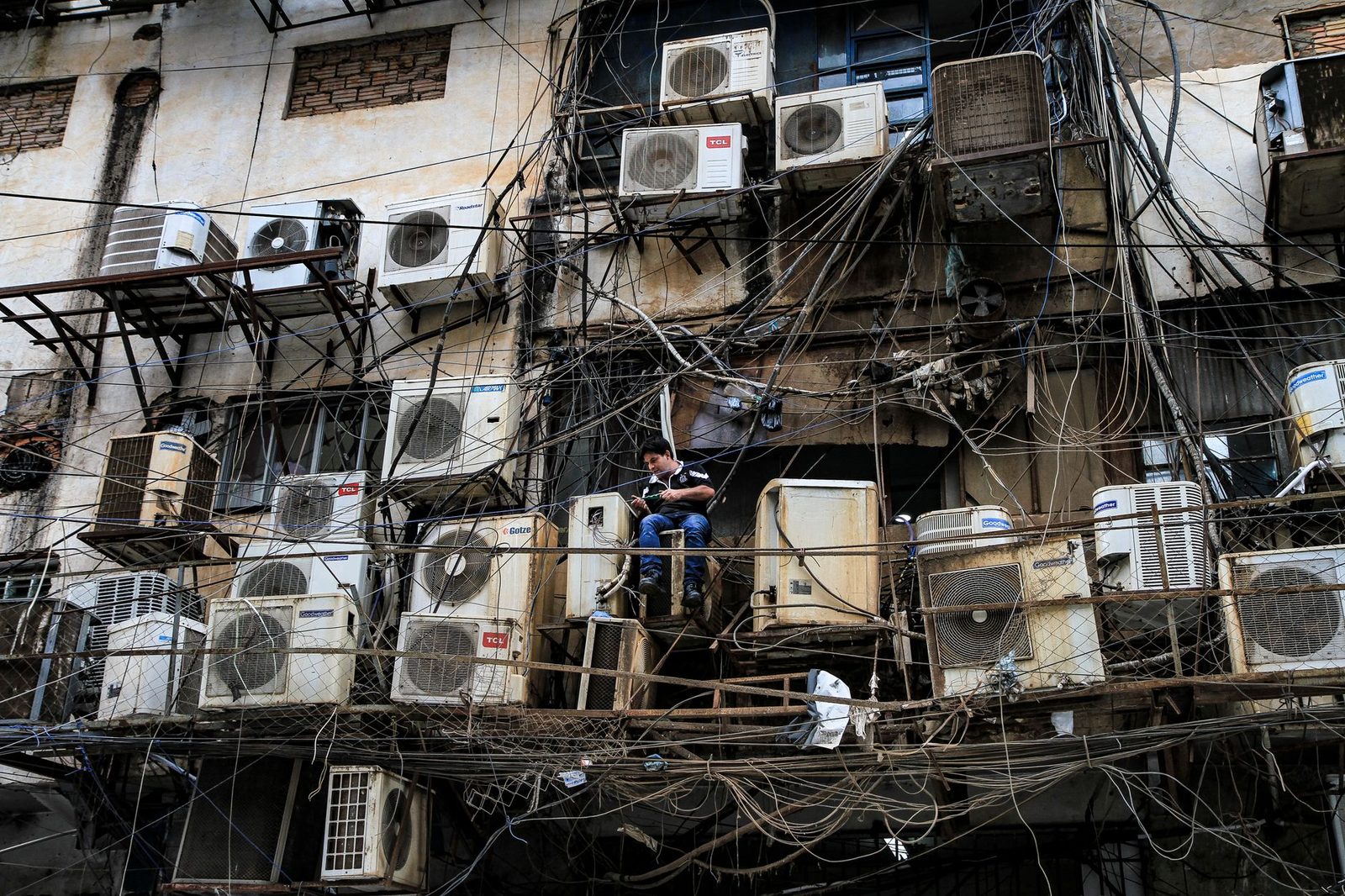
In Paris and the inner suburbs, the outdoor unit is almost always a matter for the building's co-ownership. Two practical consequences follow.
First, the tenant cannot install anything on their own. Mounting an outdoor unit on the façade, a balcony or in a courtyard affects the common areas or the building's external appearance: it requires authorisation from the general meeting, applied for by the owner. A tenant who installs a split system without these approvals risks having to restore everything at their own expense.
Second, access for servicing has to be arranged. A unit on a roof terrace, in an inner courtyard or on another flat's balcony often means notifying the managing agent or caretaker a few days in advance. Landlords are well advised to pass the managing agent's contact details to the tenant as soon as they move in.
Portable monobloc air conditioners escape these constraints, but not without trade-offs: low efficiency, noise in the room, and above all the need to seal around the exhaust hose. A window sealing kit for portable air conditioners limits warm air coming in and clearly improves the result, provided the building's rules do not prohibit a hose at the façade.
Reducing the scope for disputes
A few simple habits are worth more than a well-drafted lease clause.
- Describe the unit in the inventory: brand, model, number of units, year of installation if known, apparent condition.
- Set out in writing who books the annual service and at what time of year. An appointment in spring, before the hot season, avoids the long waiting times of July.
- Provide spare filters when the model uses them, and leave in the property a set of filters for a wall-mounted air conditioner matching the unit's reference.
- Equip the room with a measuring device. An indoor thermometer-hygrometer helps the tenant describe a fault objectively: "26 °C measured with a 22 °C setting" is far more useful than "it's not cold enough".
- Keep all reports in one place, for the landlord as well as the tenant.
Sharing the costs of an air conditioner in a rented home is not obscure at all: routine maintenance to the tenant, structural issues and wear and tear to the landlord, and work on the refrigerant reserved for companies holding a certificate of competence. The rest comes down to what is written: the lease, the inventory and the service reports.
Are you a tenant, landlord or property manager looking to arrange air conditioner servicing in the Paris region, with a clear invoice and report for each party? You can book an appointment online or take a look at our air conditioning maintenance services.
Ready for cooler, healthier air?